In any case, this year, the year I decided it was time to saddle up again, I've been overwhelmed with the interest and enthusiasm of my friends, participants and clients at my pending race and it's made me realize that a lot of people would probably be willing to tri and tri if only they had a bit more insight as to what a race day is like. So I'm devoting this post to an editorial of my Olympic triathlon at UBC on May 16, 2010. I'll try to give some tips, some insight and little bit of my story along with a few pics. Maybe by the end you'll be looking up swim clubs in your community or surfing the tribc.org site to find your first event. I sure hope so!
First a few Tri Tidbits: Triathlon comes in a few shapes and sizes. You have the Ironman, which is a 3.86 km swim, a 180 km bike , followed by a full marathon of 42.2 km just in case you weren't tired yet :) And for the record, no, I have no desire to complete an Ironman. Period. Then you have the 1/2 Ironman, which is half of all that, except the swim is actually 2km so it's a little more than half. Then you drop down to Olympic distance, which is typically a 1.5 km swim, 40km bike and 10km run. Lastly is your typical entry level sprint. Traditionally, a sprint is a 500m swim, 20km bike and 5km run, although you will see variations in this. Also, sometimes you see a "short" which is even shorter than a sprint and is great for total newcomers and also for kids/teens.
I have done several sprints and a few Olympics, and one 1/2 Ironman in my 10 years of triathlon. In order to train for a half Ironman, you need to dedicate about 15 hours a week to the training. About twice that for Ironman; about half that for the Olympic (7 hours) and about 3-4 hours a week for a sprint. The difference also lies in the length of training. Usually you train for Ironman for 9-12 months. Half Ironman, about 4-6 months; Olympic about 12-16 weeks, and a sprint can be prepped for in 3 months or less, depending on what ability level you come into it with.
All that said, as I endeavored to take on the Olympic Triathlon this year, a few things rang in my head.
1. I've done a half ironman, so I know I can handle lots of training.
2. I haven't raced in 5 years, so I know I need a lot of work.
3. I have 2 kids and I work, so I have no idea if I have the time!
As it turned out, my general fitness level was able to make up for a lack of training right up to the end...with the exception of a last minute injury (due to lack of training) that almost cost me even taking part. But that's another story. So, first, decide how many hours a week you really have, and then choose a race far enough away to prep properly. Remember that lake and ocean swims require extra training (and equipment), and that if you have kids, you can count on at least 1-infinity weeks off of training in the winter months due to the variety of viruses that attack entire families of children under 8 years old......ahhh, the joy of germy children.
For this race, I planned for 7 hours per week of training over the course of 13 weeks. What I ended up with was 3.5 hours of training over 9 weeks due to aforementioned illnesses, work travel schedule of husband, my own work schedule and my inability to get up at 5am no matter how much I told myself I wanted to. That's where my general fitness and experience in doing the events helped me. I "managed" to get by. But let's face it, I would have done better, felt better and not hurt myself if I had gotten my 7 hours of training. And let me tell you - I will NOT race unprepared again.
Okay, so enough of all that. Let's get on to the race!!!!!!!!!
Thursday, May 14th - 8pm. My right shoulder lets out a tearing burning sensation suddenly as I lift my elbow and "poof"; just like that, I cannot move my arm without pain. This was my own fault. I had only trained up to 1200 metres and had only had time to train in a 25 metre pool. Panicking, 3 days before the race, I headed to a 50 metre pool and swam 1550 metres as hard as I could. apparently the rotator cuff doesn't like that. (I do know better - and please - DO NOT TRY THIS AT HOME!).
Friday - May 15th - spend the day depressed that my race is out of the question. Get an emergency last minute squeeze me in at the end of the day (8pm) appointment with my fabulous physio. I cry on his shoulder (no pun intended) and he lasers me, assesses me, ultrasounds me, stretches me etc etc and tells me that I can race without doing further damage, but that it's gonna hurt and I'm not going to be able to go "all out"....DONE. Decision made in that moment that I will race.
Saturday - May 16th - get more great advice from a participant in my bootcamp who is a doctor. She told me what to take and how much to take for pain/anti-inflammatories. I head straight to the drug store. I'm all set. Of course, I'm still in tons of pain and have no idea how to do this and not die in the pool LOL. Time to start getting ready
Saturday afternoon - Michael takes my bike in to one of the designated pre-race cycle checks to save us time Sunday morning. Bike is fine. Helmet is fine. BTW, my bike's name is ISIS (Goddess of women,mothers and children/also known as the goddess of magic). I had her custom built at la Bicycletta in 2003 when I was training for the New Balance Half Ironman and she is still perfect and worth every dollar.
** Tip** Remember, you don't have to race with a road bike, but you will have to have a bike that is in mechanically good repair and a helmet that is approved. A good idea if you are going to race on a mountain bike is to put road slicks on it. It will buy you many minutes!
After Michael returned, we decided my seat on ISIS is set too far back. He adjusts it and I jump up and say "yep" and he completes the adjustment. (fyi, this will be important later)
Saturday night - pack my bag and eat a big carbo-loading dinner. No booze. Lots of water.
** Tip** Remember to always pack your bag in advance and if possible, prepare a "what to take" checklist way before that, so you can add to it and take things off of it as you prepare for your race. It's better to have too much stuff, than not enough. A nice day that you may not wear warm gear on can quickly turn into a day that you need full fingered gloves and booties for the ride. I once showed up at an Olympic distance race at a lake with NO SOCKS . Yes, no socks. Thank god for the well prepared lady who lent me her spares. Needless to say, I always pack 3 pair now :)
Sunday morning 7am - what to eat, what to eat. I always try to eat normally on race day so I don't invoke the G.I gods into fury. On this particular occasion I had 2 poached eggs and half a whole wheat english muffin. Had a cup of coffee too. Then I started hydrating. Constantly.
8am - leave for the race. Bike, bike shoes, runners, all other gear, camera and I.D are all already in or on the car from the night before. If you are like me, once nerves kick in, the brain turns off. Better to be prepared ahead.
9am - arrive at UBC. Michael drops me off with my bike and goes to find parking. First you head to cycle check in. Set up your station. This is when you start checking out all the other athletes. hmmm, he put his shoes behind his bike and his helmet on his seat. hmmm, why did he put his towel under all his biking gear - won't he need it to dry off and end up dumping all that stuff on the ground anyway? These thoughts mess with you.
** Tip** These things can also help you. LOOK AROUND at the other stations. A nice bike is usually (not always) an indication of an experienced triathlete. check out how they set up their transition. Mentally go through the transition in your head and set it up how it will work.
9:15am - Pick up race bag and sign waiver. This bag is also your wet bag. You put anything in it that you want when you get out of the pool. for me, this was my bike suit (which could also serve as a swim suit and next year it will, to save me 2 minutes). I had only swum in my swim suit this time around and decided not to change things up at the last minute. But, putting on a tight fitting piece of clothing on a wet body costs time (and can actually put your back out!). At UBC, the swim comes out and then you actually have to run about 300 metres to the bike transition, so you want SHOES . I put my runners in my wet bag and my socks. I have done that run barefoot (bad idea). I have done that run in flip flops (bad idea). I have done that run in bike shoes (really bad idea).
** Tip** - make sure to check out the race map for the race you choose. Understand how the transitions work and if you will have to run from the swim to the cycle transition over rough ground!
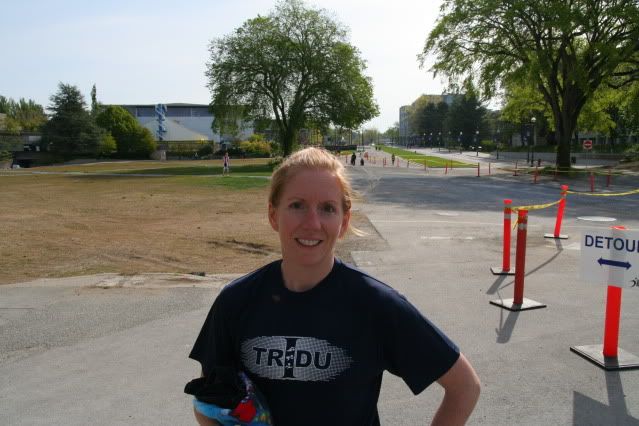
9:30am - Nervous burps are in full force. Head to the pool deck for body marking (always makes you feel so elite) and start lining up in your heat. Most triathlons that have a staggered start will ask you to estimate your swim time on your entry form. Then they have you line up from fastest to slowest. This prevents a lot of passing, collisions and swimming over people.
** Tip** - be as accurate as possible with your estimated swim time. Not only does it suck to be passed, but you risk getting kicked in the face, swallowing a bunch of water, or being swum over top. Not to mention that it is STRESSFUL when you feel someone hitting your foot and you know you are in their way. On the flip side, passing SUCKS! You have to sprint to pass, and in the pool that takes up a lot of energy. So seed yourself correctly.
Remember, all of that doesn't matter if your swim is in a lake/ocean and there is a mass start. If it's your first race, and it's a mass start, take my advice and GO TO THE BACK!
9:45am - all of us are talking and making sure we're seeded correctly. Some people are questioning their estimates and some have no idea. In the end, I seeded myself pretty well. I only had to pass 2 people and only got passed by one.
10am - It's time to race! They started us 10 seconds apart. I was so busy watching each person in front of me take off, that I didn't bother trying on my goggles until there were only 4 people in front of me. That's only 40 seconds! I spit in them (great de-fogger), reached over and dipped them in the pool and put them on my head and the right side just collapsed! My strap had come completely loose in my bag and I hadn't even noticed. With only 30 seconds left, I am frantically trying to adjust my strap and get them on my head (and I knew Michael was watching and thinking WHAT THE HELL IS SHE DOING!?). The last 3 swims they had been leaking so I knew I needed to get the strap just right. I literally got them on my head as I stepped to the edge of the pool. Too late, my nerves and panic from the google situation had my stomach doing flip flops.
**Obvious tip** - make sure your goggle straps are set right!
Here I am, messing around with my goggles (I'm in the red and black two piece)
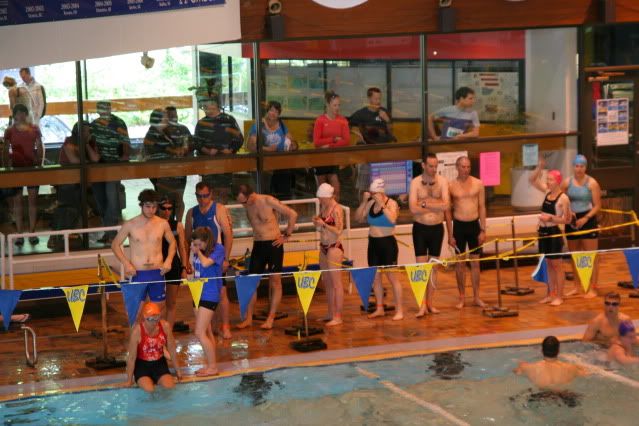
And then, I was off. As opposed to everything I know about racing injured and racing in general, I went out too hard, especially given my shoulder situation. The first 100 metres were torture on my shoulder and my stomach was doing flips. My heart rate was through the roof. At the end of the first lap, I had to calm down.
For the Olympic distance at UBC, you swim 50 metres down, 50 metres back, then duck under the rope and do it again for 8 laps. Then you jump out, run back to the start and do another 7 laps. Not the most efficient, but not horrible either. All the ducking and the little break to run probably cost you a total of a minute or less.
First Lap!
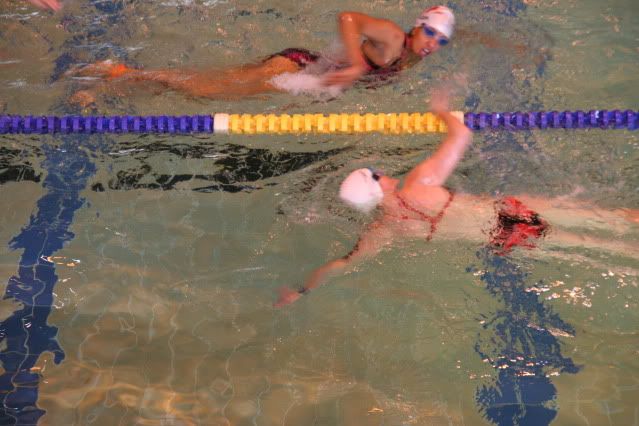
Last Lap!
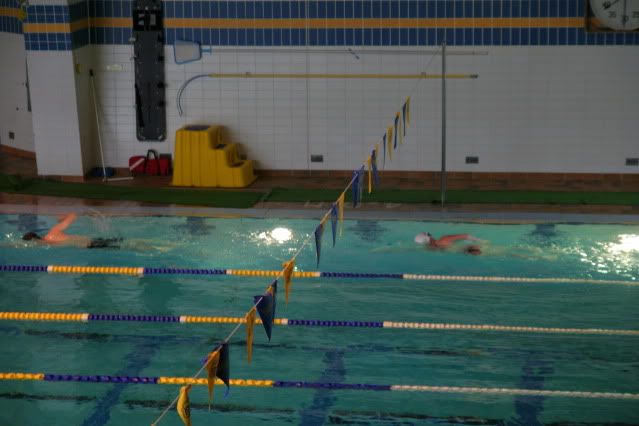
After 400 metres, my shoulder stopped hurting and I settled in to my stroke. At 1 km, my shoulder woke back up and the last 500 were tough, but manageable. I have NEVER been so happy to get out of a pool . Although I'm glad I raced, I won't race injured again. It wasn't fun and I am paying a bit for it now.
But who cares! I'm out of the pool! They don't let you run (for obvious reasons) on the pool deck , so I put on my best hip swaying power walk and boogied out of there. This is where it would have been a time saver to already have my skin suit on. It took me about 2 minutes to get it on (maybe a bit less). 2 minutes would have bought me 2 placements in my age group and over 10 placements overall!
My original estimated swim time was 32 1/2 minutes. I revised it to 35 minutes a week before the race and got placed in a different heat when I realized I had not done nearly enough swimming. On race day, I seeded myself for 37 minutes given my shoulder situation.
In the end, I did it in 36 minutes and was totally happy with that.
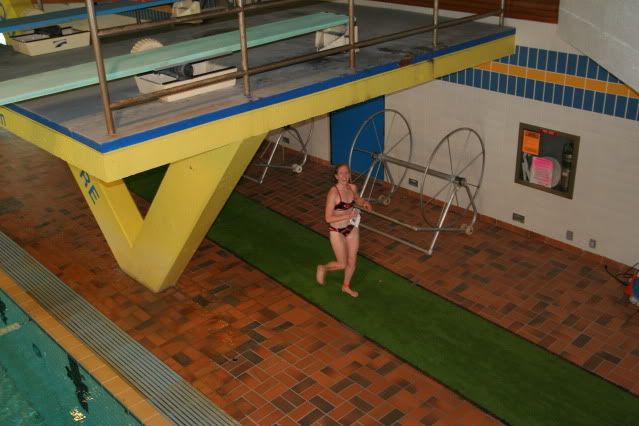
Now for the REALLY tough part :) The race is not controlled by the swim. Sure, you can lose it in the pool. If you are not prepared and cannot go the distance, you can exhaust yourself completely, but the reality is that most people have a range of "bad swim" to "good swim" that only varies by a few minutes.
The bike is the bad ass.
It's the longest portion of the race.
It's the only part of the race where you can have a mechanical advantage.
It takes training and skill.
If you don't practice biking, you will kill your legs and not be able to run on those jello sticks.
Heading from the pool to the bike transition
I had my station set up exactly as I wanted it. UBC has a very very strict rule about helmets in the bike transition. You MUST put your helmet on BEFORE you lift your bike off the rack. It must stay on your head until your bike is re-racked. They WILL give you a time penalty and make you put your helmet back on and back off if they catch you breaking this rule.
*Tip* - Always wear bike gloves. Always! Why? First of all they add cushioning and absorb shock that doesn't then travel up to your already tired shoulders and neck. But more importantly, if you fall off a bike -you will throw your hands down, guaranteed. So protect them!
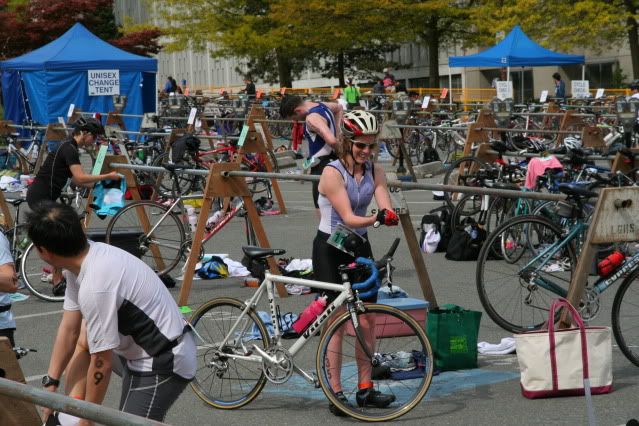
And with the swim soundly behind me (although still ringing in my head), I headed off for a projected 80 minutes ride....
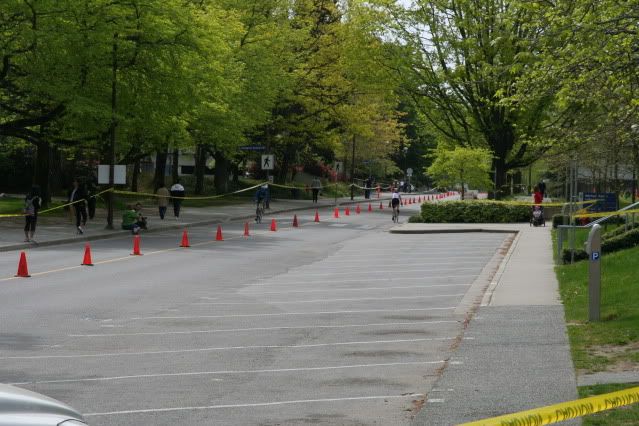
.......And exactly 10 seconds later, my bike seat fell off.
Remember that little adjustment we made on Saturday? We didn't tighten the seat back up properly. OOPS. I was literally hanging off the back of my bike, contemplating laying on the ground and crying or screaming Michael's name (which wouldn't work b/c you aren't allowed outside help). Then I remember my little tool pouch and prayed that Michael had put the allan wrench in. Yes, I am one of those women who rely on my husband to be my "crew". Absolutely not his responsibility, but BLESS. HIS. HEART. It was there .
It cost me 2 1/2 minutes, but I couldn't have gone anywhere if I hadn't fixed it.
** Tip** - TAKE YOUR BIKE for a final test drive the morning of the race!!!!
The ride was fabulous. The ride was TOUGH. 40 km spread over 4 loops for the Olympic distance, and each loop ended on an uphill climb. Ugggh. A very tight turnaround (there were several accidents during the race) but I'm very cautious on tight corners and I rode in a triathlon bike club for years so I know how to lean and position my body.
All the way out on each loop was flat/downhill and the wind at our backs.
All the way back was a slow climb/flat and wind in our face, followed by that uphill stint before the turnaround.
But honestly, legs screaming and heart pumping, all I could think about was "HOW AMAZING IS THIS DAY!!!!!!!!!" (and how happy am I to be out of the pool!)
Here I am climbing up to the turnaround lap 1
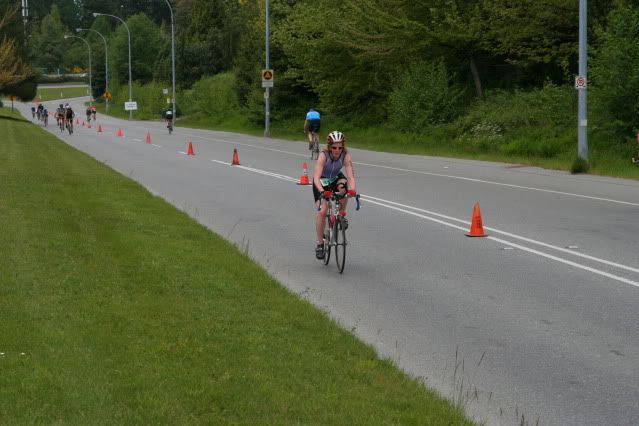
And then enjoying the 20 seconds downhill back out for the next loop

The volunteers at UBC are amazing. There was one particular volunteer controlling a major intersection with cars waiting and cyclists coming from 2 directions through an s-curve. She was yelling directions at the top of her lungs for about 3 hours. She rocked and I told her so.
** tip** THANK the volunteers! Races could not happen without them and it takes ZERO effort to shout "thank you" as you pass a couple of them by!
And finally, coming in to the transition 40km later (85 minutes on bike including seat re-attachment)
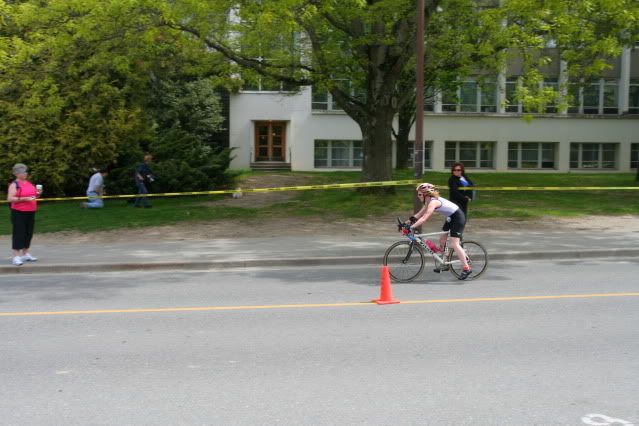
All triathlons have a strict rules about dismounting before the dismount line. People will be yelling at you, screaming at you if you aren't dismounting at least 8 feet before the line. Get your feet un-clipped and get OFF. Trust me, you don't want a DQ (disqualification) or a time penalty for breaking this rule.
Then it was run/wobble/walk back to my transition spot for the last leg. At this point, I had total jello legs and my pelvic joint felt like I had been kicked with a steel toed boot. Partly b/c I had rushed the seat re-attach and had done it on an angle so I had been riding angled up the whole way, which made my adductors have to do a lot of work (inner groin).
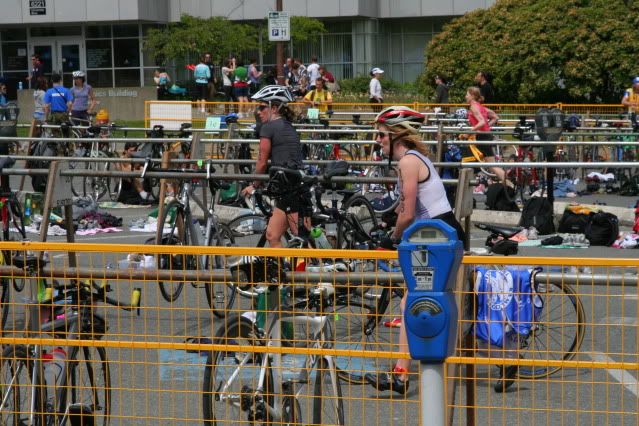
Also, I had packed my "bike snack" (a powerbar) in my vest pocket.
I 100% planned to wear my vest.
100%.
But, it was warm and I was frazzled and I didn't put on my vest. So, I had no snack on the bike. Because I had planned to have a snack on the bike, and because I hadn't trained with any energy drinks, I had no Gatorade. So, I had now completed 2 hours of intense exercise on just water...my stomach was GROWLING. This is a rookie mistake that I should not have made. I have no excuses. Just stupid.
**tip** Train with an energy drink, bars or gels if you want to race with them. You can't expect your body to process and respond to these things on race day if you haven't practiced with them. That said, make sure you have your snack on your bike or your bike clothing. Some triathletes warm up their energy bars, take them out of the pack, and mold them around the handle bars so they are there to peel off when they need them. You think that's gross?
Where do you think Ironmen pee?At this point, I was a bit frazzled and Michael was on the other side of the fence right beside me/my transition spot saying very encouraging things (which I cannot recall now). I do know that as I reached down and grabbed blue bandana, he said "ahhh, there he is, and on he goes" and at that moment, my mental strength came pouring back (see blog post titled 'smelly old things' if this has you scratching your head)
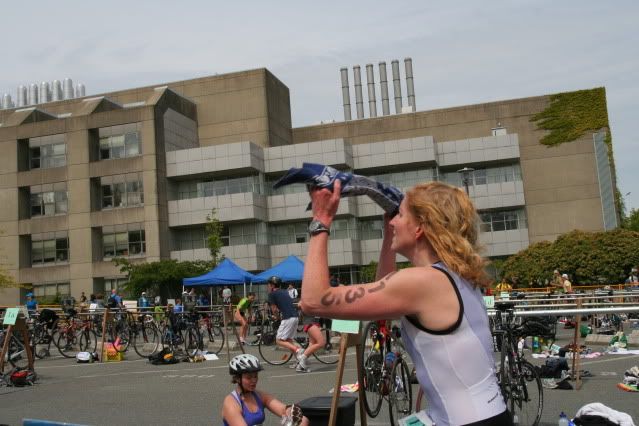

And I was off like a cheetah. Okay, well, off like a turtle. I knew for sure my legs were moving because I could see I was passing by trees and people, but it felt like I was wading through concrete. No matter how many times I do it, I will never cease to be amazed how CRAZY your legs feel on the bike to run transition.
**Tip** Be sure to throw 'brick' workouts into your training plan, which let you practice back to back modalities like swimming and then biking. Most important is to practice biking and then running because it is a truly unique feeling!
A little rant:
300 metres into the run, a well meaning volunteer shouted at me "You are almost done!" I love volunteers. God bless them all. But seriously? This person has never done a triathlon. You DO. NOT. YELL. 'YOU ARE ALMOST DONE'. TO SOMEONE. WHO. IS . ABOUT. TO. RUN. 10 KM. AFTER BIKING 40KM!!!!!!!
Okay, rant over
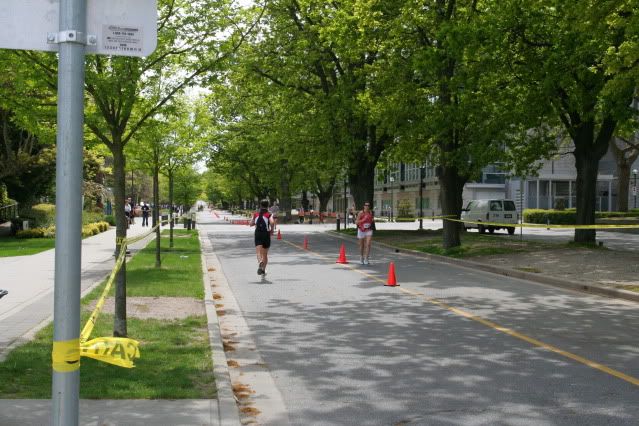
That first 1km felt like 10km. Luckily there was an aid station at 500 metres and I grabbed some poweraid! I had also grabbed my power bar but I couldn't chew and run so I turfed it. It's a good skill to be able to squish those tiny paper cups into a funnell and master drinking while running. Highly recommened.
Kilometres 2, 3 and 4 felt faster and faster. No one had passed me and I had passed 5 people! Woot! I was taking in all the sights and sounds. UBC is such a beautiful campus. I was having a blast. We looped back and then I passed the 4km mark. At this point, all the competitors doing the sprint distance turned up towards the finish. As I watched them go, all I could think is.."I have another 6km to go"....just one little defeating thought, but it was enough... and the fatigue set in. My heart rate went up and my right quad started to seize.
I struggled for a kilometer and a half, but miraculously, kept passing people and no one passed me. After 6km, out on Northwest marine, I was dejavue'd back to living at UBC and doing this run hundreds of times. The next thing I knew, I was at the 7km turnaround.
Two things happened.
1. I dumped a cup of water over my head and as I did, my hand touched my bandana and a thought ran through my entire body. 'YOU ARE A RUNNER AT HEART BABY, SO RUN HARDER!'
2. I experienced the much sought after, very elusive, truly amazing 'runner's high'. (insert image of heaven here - ha ha ha)
It doesn't usually happen to me on short distances. But it did on Sunday May 16 at 7.5 km on the run route. I literally FLOATED through a Kilometre and a half. I could honestly only hear the birds and the wind. I only felt happy and light. I was yelling "great job" at every runner I came face to face with who was headed for the turnaround and saying "great run" to every runner I passed (14 in all!). Heaven. Pure Heaven.
And then the 9km marker was beside me and.....I came back to earth with a CRRRRAAAASSSSH! Ugh. Heavy legs, cramping legs, high heart rate, growling stomach.
But it was too late for any of that to ruin my day !!! :)
And as any racer knows, the last 10% is always about mind over matter. So I ran and ran and ran.
As I rounded the corner for the finish shoot, there he was. My biggest fan. At every race. Always with a big smile and a camera. My love! I had been thinking of his support ALL DAY. I couldn't wait to give him a big sweaty hug!
As always, with the finish line in sight, a new burst of energy overtakes me and a huge smile crosses my face
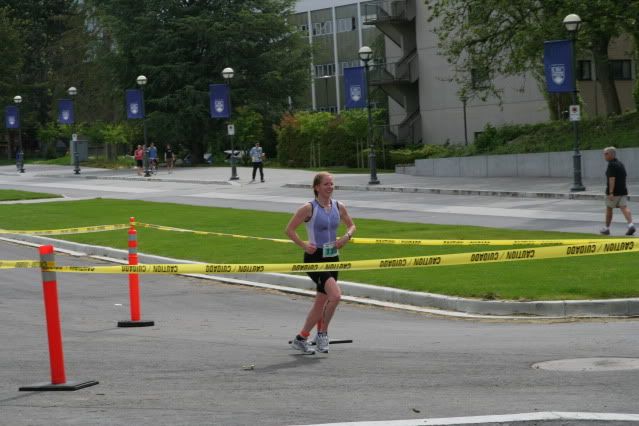
Here I come to the finish chute :)
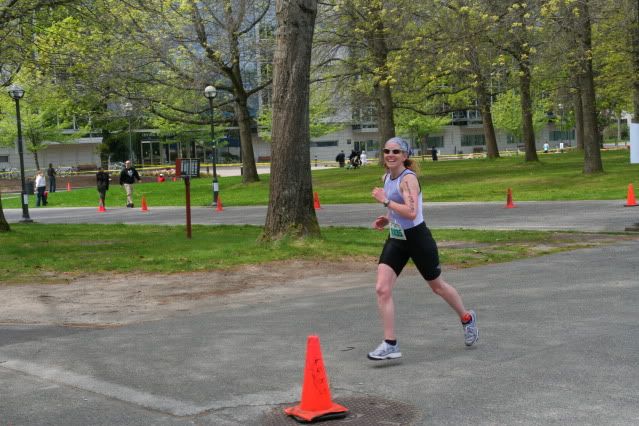
As they called out my number and name, I felt overjoyed. No, it's not the Ironman or even the half iron man, but it was a big accomplishment for me, for now, and I was beaming ear to ear. The volunteer waiting on the other side of the line handed me my souvenier water bottle and said "You have the biggest smile I've seen all day". Yep, that' pretty much how I felt!
And here's the only official photo from the race (Michael took all the others)

Every race, I try to learn a couple of things. So here are my takeaways from this one:
1. Don't race injured. It's stressful, dangerous and makes you feel bad. I should have learned that at the half iron man...but I guess it faded from memory :)
2. Check my equipment right before the race (goggles/bike)
3. Fuel myself properly in training so I can fuel myself properly on race day
4. Be proud of DOING MY BEST once race day is here. Everything that went right or wrong is done. Just have fun!
And at the end of the day, I had originally estimated a 2:52 finish, which would have placed me top 3 in my age group. I threw that out weeks ago and was planning try to hit 3 hours. After the injury, I had ZERO expectations and wouldn't have been surprised to see 3:30 especially with the bike seat fiasco.
So....I was beyond thrilled to hit 3:04:49!!!
It put me 7/14 in my age group and 145/245 overall for the Olympic event:) Next year will be better, but this year was great.
Swim 177/245
Bike 163/245
Run 95/250 (you're a runner at heart baby!)
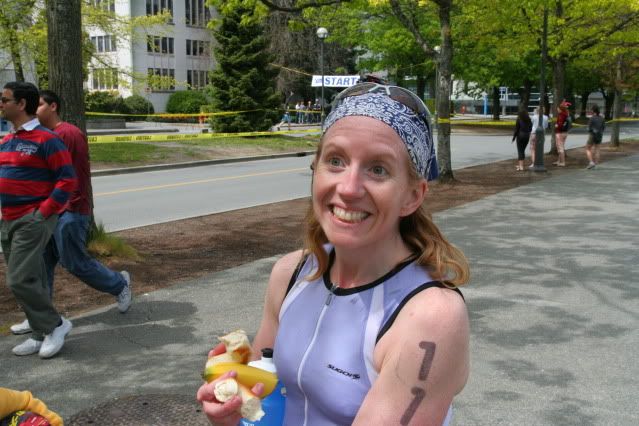
I know it was long and rambling, but hopefully you found something in there to help you improve your race and learn from my mistakes, or maybe a tiny seed of inspiration to tri that first tri.
As for me, I generously watered and shone sunlight on that little seed in my soul that is a fitness freak and my race mojo is BACK!